
How to Detox From Weed at Home: What Actually Speeds It Up (and What Does Not)
It's Sunday night. The offer letter came Friday, the screening is Wednesday, and you've had the same tab open for an hour: how to detox from...
Read more »




The short answer
The worst nights are usually the first five. After that, sleep gets better in an uneven way over the next few weeks. For most daily smokers it feels clearly better after about seven weeks. After years of heavy daily use, it can take up to about three months until your sleep feels fully like yours again.
This is how it usually runs, in the three phases our program uses:
Your sleep in the three phases after quitting
Release is also when the urge to smoke just to get some sleep is strongest. The second dip in Resilience feels like going backwards: a few good nights, then waking every two hours again. That dip is normal, and it passes.
If sleep trouble lasts longer after very heavy use, that doesn’t mean something is wrong. Your sleep system simply has more to rebuild.
Cannabis suppresses REM sleep. That’s the deep dreaming phase where your brain sorts memories and does most of its overnight repair work, and it was being held back every time you smoked. Your brain adapted. It stopped running REM at full strength because THC was doing part of the job.
Stop the THC and the system overcorrects. REM sleep rebounds sharply. Your brain rushes into REM earlier than normal and stays there longer.
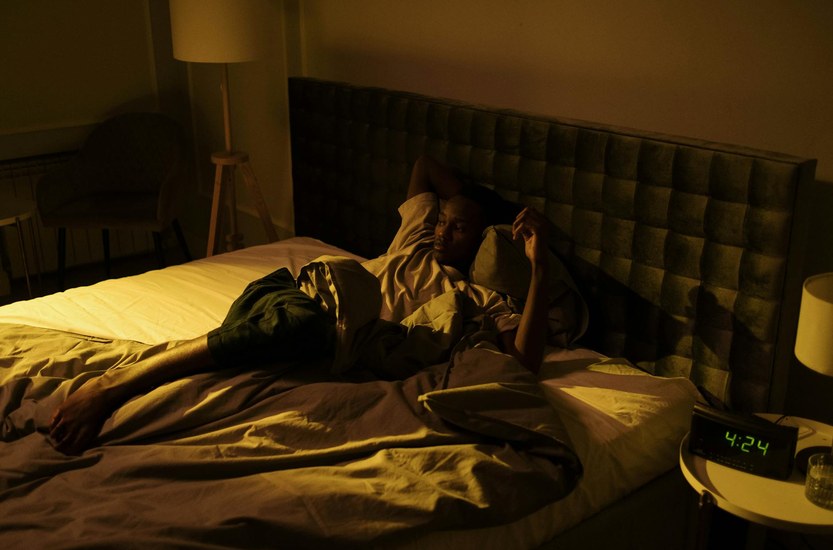
The result is what you’re going through: vivid and often disturbing dreams, several wake-ups in the middle of the night, and that feeling of being technically asleep but not rested. You might fall asleep fine and wake up at 2am wide awake. Or you can’t fall asleep until 4am even though you’re exhausted. Both have the same cause.
Why this matters: if you treat withdrawal insomnia like any other sleep problem, you reach for things that make it worse. Alcohol knocks you out but breaks up REM even more. Strong sedatives hold back the very process your brain needs to finish. What you need is to support the recovery, not suppress it again.
Sleep is only one part of withdrawal. For the full picture of what to expect and when: Weed Withdrawal Symptoms: What to Expect and Why It Happens
The worst nights are usually days two to six. That’s when the withdrawal itself peaks and REM rebound kicks in hard. By the end of week one, most people notice the first improvement: the wake-ups are shorter and the dreams a little less overwhelming.
The recovery is not a straight line. Most people get a wave pattern: a few better nights, then one rough night, then more stability. The direction over time is what matters, not any single night.
We’ve seen this again and again. People are sure they’ve turned a corner on night eight, sleep badly on night ten, and think they’re back to square one. They’re not. One bad night inside an improving trend is still an improving trend.
By week three to four, sleep is usually workable for most daily users. By around week seven, many people say they sleep better than while they were smoking, because they’re finally getting full REM cycles again instead of the held-back sleep weed produces.
How long you used and how heavily. The longer and heavier the use, the more deeply suppressed your natural sleep system became. Recovery takes proportionally longer.
Whether you used it specifically to sleep. If weed was your primary method of falling asleep every night for years, your brain has essentially forgotten how to do it without help.
Anxiety levels. Weed suppresses anxiety temporarily. When you quit, anxiety often spikes in the first two weeks. Anxiety at bedtime is one of the most powerful sleep disruptors there is.
Your stress load during the quit. Quitting during a calm period tends to produce milder sleep disruption than quitting during a demanding stretch of work or exams.
If you smoked every night to switch off, weed did three jobs for you at bedtime. Each one comes back on its own schedule. It helps to know which one is missing on a given night.
The three jobs weed did at bedtime
| The job | When it usually comes back |
|---|---|
| Knocking you out | Within the first two weeks |
| Switching off your thoughts | Takes longer, often behind the second dip in weeks 3 to 4 |
| Signaling bedtime | Not by waiting, a new routine takes 2 to 3 weeks to stick |
The knock-out. THC sedated you. That heaviness is the first thing to return, usually within the first two weeks, because your body still knows how to get tired on its own.
The off-switch for your thoughts. Weed never quieted your thoughts. It made you stop caring about them. Without it, the worries have teeth again at 1 a.m. This takes longer to rebuild, and it’s often what the second dip around week three or four is made of.
Two things help. Don’t do the thinking in bed. And give your thoughts a slot earlier in the evening, on paper or out loud, so 1 a.m. isn’t the first time all day you’re alone with them.
The bedtime signal. For years, the last thing you did before bed was smoke, and your body learned that as the start of sleep. That signal doesn’t come back by waiting.
You need a new one: the same few steps in the same order at roughly the same time. For example shower, kitchen light off, one chapter, lights out. It usually takes two to three weeks of repetition before it sticks.
Short nights also eat willpower. In a sleep lab study with daily users, just three days without weed cut total sleep time and sleep quality and made falling asleep take longer. And in a survey of 469 adults who had tried to quit, 70% of those with a full withdrawal syndrome said they used weed to ease it.
So plan for it. If you can, start your quit so the first four or five nights land on days when you don’t need to perform. After a bad night, take a long walk in daylight the next day instead of a nap, because a nap moves the sleep debt to the following night.
Magnesium glycinate in the evening. This is the most useful single thing for withdrawal insomnia. It doesn’t sedate you. It calms the overactive nervous system that’s keeping you awake.
During withdrawal your body still makes stress hormones at higher levels, and magnesium supports the GABA system that brings the nervous system back down. Take it every night, not just when you think you need it. Read more: Magnesium for Cannabis Withdrawal: What It Does for Anxiety and Sleep
CBD oil in the evening. CBD slows down the enzyme that breaks down anandamide, your brain’s own calming molecule, which runs low during withdrawal. The result isn’t sedation. It takes some of the anxiety and tension out of the way of falling asleep. CBD does not get you high, and how CBD differs from THC explains why.
For most people the effect is subtle but real: the lying-awake-and-wired feeling is less intense. Taking it every day works better than an occasional big dose. Read more: CBD Oil for Cannabis Withdrawal: Does It Actually Help?
A fixed wake time, no exceptions. This is the strongest lever you have over your sleep right now. Get up at the same time every morning, even after a bad night, even after three hours of sleep.
A steady wake time is how your brain learns day and night again. Sleeping in to make up for it breaks up the next night’s sleep even more and pushes the recovery out longer.
Morning light. Get outside or near a bright window within 30 minutes of waking. Morning light resets your body clock and sets up melatonin for that evening. During withdrawal your sleep-wake rhythm is off, and morning light is the best reset signal you have.
Cool down before bed. A drop in core body temperature is one of the signals that starts sleep. Keep the bedroom cool, and try a shower or an easy walk about an hour before bed.
Melatonin if falling asleep is the main problem. Start with a low dose, not the high-dose products most pharmacies sell, and ask a pharmacist or doctor if you take other medication. Higher doses can make dreams more vivid, the opposite of what you need right now.
Melatonin helps you fall asleep. It doesn’t help you stay asleep. If waking up in the middle of the night is the main issue, magnesium and CBD will do more. Read more: Melatonin for Weed Withdrawal: Does It Actually Fix the Sleep?
Free E-Book
You want to quit weed, but it feels impossible to actually stop?
Our free e-book shows you why willpower is a lie and the exact steps you need to quit for good. Enter your email below and we’ll send it to you for free.
Alcohol. This is the most common mistake. Alcohol puts you to sleep, which feels like a solution at midnight. But it breaks up your sleep badly, makes the next day more anxious, and is a well-worn path back to relapse. Avoid it completely in the first two weeks, especially at night.
Checking the clock. Every time you look at the time when you wake at 3am, you switch on your brain’s alarm system. You do the math, how many hours are left, how bad tomorrow will be, and your brain gets even more awake.
Turn the clock away. Put the phone face-down. It sounds trivial and makes a real difference.
How lying awake keeps itself going
Caffeine after midday. During withdrawal your nervous system is already on edge. Caffeine that would normally be gone by 6pm is still working later. Move your cutoff earlier than you think you need to.
Lying in bed trying to force sleep. The harder you try, the more your brain links the bed with being awake. If you’ve been awake for more than 30 to 40 minutes, get up, go somewhere dim, do something quiet, and go back when you’re really drowsy.
You woke up and you’re not getting back to sleep quickly. Here’s what helps instead of lying there and spiraling.
Get up. Go to another room. Keep the lights low. Drink a glass of water. Do something that takes just enough focus to stop the loop but not enough to wake you further: a paper book, a crossword, slow breathing. Don’t use your phone, don’t watch anything exciting, and don’t start planning your day.
When you feel really drowsy, eyes heavy and not just tired, go back to bed. Most people are back asleep within 20 to 40 minutes this way. The goal is to break the lying-awake-and-anxious loop, not to find a trick that forces sleep right away.
If your sleep hasn’t improved at all after about seven or eight weeks, talk to a doctor. Sometimes the disruption is simply more severe than typical withdrawal. Sometimes there was a sleep or anxiety problem before you ever smoked, and the weed only covered it up. That isn’t a reason to go back to smoking. It’s a reason to treat sleep as its own issue once the rebound is over. If sleepless nights come with racing thoughts or paranoia, read whether withdrawal can trigger psychosis.
If you ever feel unsafe or have thoughts of harming yourself, contact your local emergency number or a crisis line right away.
Withdrawal insomnia is temporary and predictable, and you can get through it. The first week of nights is hard, and after that the pattern is uneven but keeps getting better. The REM rebound is your brain catching up, not something going wrong. On those 3am wake-ups, you’re on schedule, not failing.
If you want a structured way through all three phases, sleep included, our Cannabis Detox Program is built for exactly that.

About the author
Sabrina S. · Health Coach, QSW Team
Sabrina is the health coach of the QSW team. Like everyone on the team, Sabrina knows cannabis from personal experience and covers what your body goes through when you quit: sleep, sweating, appetite and recovery.
More about Sabrina →It's Sunday night. The offer letter came Friday, the screening is Wednesday, and you've had the same tab open for an hour: how to detox from...
Read more »
Day three. You're at the kitchen table with the cuff still on your arm, and the number is 148 over 94. Two weeks ago, still smoking...
Read more »
You expected the irritability. You braced for the bad sleep. But the stomach stuff catches a lot of people off guard. You stop smoking and suddenly...
Read more »