
How to Detox From Weed at Home: What Actually Speeds It Up (and What Does Not)
It's Sunday night. The offer letter came Friday, the screening is Wednesday, and you've had the same tab open for an hour: how to detox from...
Read more »


The short answer
Over months, quitting takes a daily load off your heart and vessels. THC pushes your pulse up every time you use. For a daily user, that means a small stress test several times a day, every day, for years.
Take that away and your heart and blood vessels can run a calmer program. That’s the half the rehab sites give you.
The half they skip: in the first two to three weeks, blood pressure often goes up, not down. Not for everyone, but for enough people that Johns Hopkins researchers wrote a paper about it.
If you measured this morning and the number was higher than it has been in months, you’re not the exception. You’re in the part of the timeline nobody warned you about. And that part ends.
Within minutes of smoking, your heart rate climbs. Lab studies usually measure a jump of 20 to 30 beats a minute, and some have seen average jumps above 40.
The blood vessels widen, which is why your eyes go red, and the heart pumps harder to keep pressure up in a bigger pipe. Sitting down, blood pressure usually creeps up a little. Standing up fast, it can drop. That’s the head rush you probably stopped noticing years ago.
Here’s the part that matters for the reading on your kitchen table. When you do that every day, the body stops treating it as an event. Tolerance builds. Your resting heart rate and pressure settle around the daily dose, the way a thermostat settles around whatever the room usually is.
Your “normal” for the last few years wasn’t measured without weed. It was measured with weed as a constant in the background. The cuff never showed you your own baseline. It showed you your baseline plus THC.
That changes the question. Quitting doesn’t lower or raise your blood pressure. It removes a constant and lets you see the number underneath. The catch is that you don’t get to see it right away, because withdrawal gets in the way first.
What years of daily use do beyond the pulse is a separate story, and we laid it out in Long-Term Effects of Daily Weed Use.
In 2011, a team at Johns Hopkins put 13 daily cannabis users in a research unit. They let them smoke for two days, then stopped them for three, and took their blood pressure three times a day. They ran this cycle twice.
Across the group, systolic pressure rose about 10 points and diastolic about 7 points during the days without weed. Six of the thirteen rose more than that, by up to 22.8 systolic and 12.3 diastolic on average. You can read the paper here: Increased blood pressure after abrupt cessation of daily cannabis use.
What the Johns Hopkins study measured
| While smoking | Days without weed | |
|---|---|---|
| Systolic, whole group | about 130 | about 140 |
| Diastolic, whole group | about 75 | about 82 |
| Systolic, the 6 with the biggest rise | about 131 | about 147 |
| Morning heart rate | 75 beats a minute | 81 beats a minute |
When the volunteers smoked again, their pressure went back to where it had been. Several people who had no history of high blood pressure read above 160 over 90 during the days without weed.
A German inpatient study of 39 long-term daily users a few years later found no significant change in heart rate or blood pressure after quitting. Both papers are real, and they don’t cancel each other out.
They tell you the same thing the r/leaves threads tell you: some people spike, some people don’t, and there’s no test beforehand that says which one you’ll be.
One person on r/leaves went from 105 over 65 to the 140s over 90s the day after quitting and almost drove to the ER twice. Another in the same thread was at 120 over 80 on day 15 and mostly annoyed by the anxiety. Same drug, same decision, different bodies.
Why does it climb at all? The Hopkins authors offered two explanations and couldn’t pick between them. Either the endocannabinoid system rebounds directly, pushing pressure up now that the brake is gone. Or the pressure rides on top of the other withdrawal symptoms: the anxiety, the short sleep, the sweating that wakes you at 3 a.m.
In practice it’s probably both, and the second one is the one you can do something about. If you haven’t slept properly in three nights and your shirt is soaked when you wake, your cuff is measuring that too. More on the sweating side in Weed Withdrawal Night Sweats.
This is where most of the scary readings come from, and this is where people make the mistake that keeps them scared.
By day five the worst of the physical reset is behind you, and the phase the Cannabis Detox Program calls Resilience begins: the body has mostly settled, the mind hasn’t. Anxiety comes in waves that have nothing to do with what’s happening in the room.
Here is what happens with a home blood pressure monitor during those waves. You feel your heart, you get the cuff, the number is high, and now you’re more anxious. So you take it again ten minutes later, and it’s higher.
A guy on r/leaves described exactly this: he checked it several times a day, called himself a dope for doing it, and landed at 140 over 90 again and again. His pressure was normal a couple of months later. The cuff hadn’t been measuring his blood pressure. It had been measuring his fear of the cuff.
The pulse does the same thing. One person on r/leaves, whose heart pounded for a week every time he quit cold turkey, went for a run and saw his heart rate above 180, on a run that would normally sit far below that. Another described two or three weeks where standing up sent his heart racing.
That’s the nervous system running hot without its usual damper. It is real, and it settles. We’ve watched it in ourselves and in a lot of people since: the wired feeling peaks somewhere in week two and then loses its grip week by week.
If the anxiety itself is the bigger problem for you, the mechanism behind it is in Weed and Anxiety.
What helps during these weeks is boring, and it works. Slow breathing when you feel the wave, rather than reaching for the cuff. A long walk instead of a hard run. Less coffee than you’d like, and no readings after a bad night.
Moving your body is the one thing that lowers pressure both right now and in three months, and we wrote a whole piece on why in Exercise After Quitting Weed.
One thing not to do: smoke to bring the number down. It will, for an evening, and it will also reset the clock on everything above, so that day one starts again tomorrow.

Free E-Book
You want to quit weed, but it feels impossible to actually stop?
Our free e-book shows you why willpower is a lie and the exact steps you need to quit for good. Enter your email below and we’ll send it to you for free.
Somewhere between week three and week six, the readings stop swinging. That’s roughly the stretch our program calls Clarity, which runs until about week 7.
The person who spiked to the 140s was averaging 110 over 74 by day 30, a bit above his old numbers and dropping. That’s the pattern we see most: a climb, a plateau, then a slow drift down to a baseline you haven’t seen in years.
Sometimes that baseline is a real surprise. A 35-year-old on r/leaves, twelve years of all-day use, had been running 150 over 100 at every doctor visit for years. A week in, at another appointment, the nurse read 126 over 76. He’d changed nothing else.
Nobody can promise you that. But it does say something about how much a daily substance can hide from a doctor who doesn’t know it’s there. If you haven’t told your doctor you were smoking, tell them now, because the readings from the last few years mean something different than they thought.
For the longer run, the evidence points one way. A 2024 analysis looked at survey data from more than 430,000 American adults. People who used cannabis daily had about 25 percent higher odds of having had a heart attack and 42 percent higher odds of a stroke than people who didn’t. The more days a month they used, the higher the odds, even after accounting for tobacco. Healthy vessels matter for erections too, one of the points covered in cannabis and libido.
You can read it in the Journal of the American Heart Association. A survey like this shows a link, not proof of cause. And it’s not a blood pressure number. Quitting doesn’t erase years in a week, but it does stop adding to them.
The rest of what changes at one week, one month and one year is in Benefits of Quitting Weed.
Two things sit on top of all this. If you smoked weed with tobacco, or you also smoke cigarettes, the tobacco is doing more to your vessels than the THC ever did, and it’s the next thing to look at.
And if your pressure was high before you ever started, weed was never the cause. Quitting removes one load, then the usual suspects remain: sleep, weight, salt, alcohol, movement. Those get easier to work on without weed in the picture. They don’t get worked on by themselves.
Blood pressure after the last joint
Not everyone gets the spike. The German study saw none at all. If your readings stayed flat, that’s just as normal.
If you have no known blood pressure problem and no doctor has asked you to track it, put the cuff in a drawer for the first two weeks. After that, measure once a week, not once an hour, and write it down.
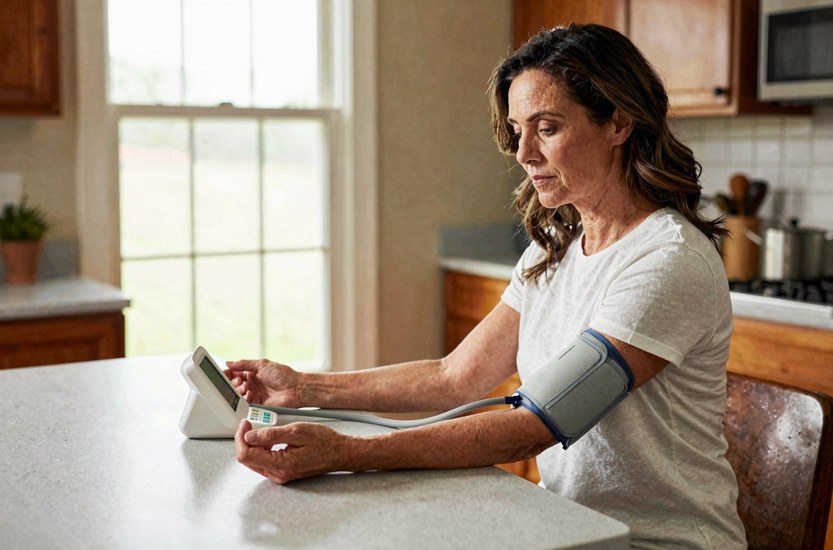
The CDC’s basics for a home reading: nothing to eat or drink for 30 minutes before, empty your bladder, sit with your back supported for at least 5 minutes, both feet flat on the floor and legs uncrossed, arm resting on a table at chest height, cuff on bare skin, no talking.
Measure at the same time of day and take two readings 1 or 2 minutes apart (CDC guide to measuring your blood pressure).
One reading after a rough night tells you about the night. Eight weekly readings tell you about your blood pressure.
Where the calm advice ends: if you already have high blood pressure, take medication for it, or have a heart condition, talk to your doctor before you quit rather than after, and tell them it’s daily weed you’re stopping. The Hopkins group said the same thing in their paper, plainly.
A hospital case report describes a 77-year-old woman who had smoked about four joints a day for many years. Her medication had kept her in the 140s over 70s. She cut down to one joint a week. At her next visit she read 224 over 90, and a week later she was still in the 220s over 90s, with no symptoms at all (case report on cannabis withdrawal and high blood pressure). Your doctor can’t plan for a spike they don’t know is coming.
And if a reading is ever 180 over 120 or higher together with chest pain, a bad headache, vision changes, trouble speaking or dizziness, call emergency services. If it’s that high without symptoms, rest a few minutes and measure again. Still that high: get medical care. Lower on the second try: call your doctor anyway and tell them what happened (Cleveland Clinic on hypertensive crisis). That goes regardless of what caused it.
Not a lower number on day three. Quitting takes a constant off the scale and, for a few weeks, replaces it with a nervous system that’s louder than usual. Then it hands you a number you may never have seen: yours.
Whether that number is good news depends on things weed was never responsible for. What you’ve done by quitting is make it possible to find out. If you want a steady path through those first loud weeks, our Cannabis Detox Program takes you through all three phases, Release, Resilience and Clarity.

About the author
Maik R. · Copywriter, QSW Team
Maik smoked weed daily for more than 12 years before getting clean with the support of an addiction counseling service, where he later worked himself. Today he writes for quit-smoking-weed.com from abroad, combining lived experience with careful research on withdrawal and life after weed.
More about Maik →It's Sunday night. The offer letter came Friday, the screening is Wednesday, and you've had the same tab open for an hour: how to detox from...
Read more »
You expected the irritability. You braced for the bad sleep. But the stomach stuff catches a lot of people off guard. You stop smoking and suddenly...
Read more »
You've been doing fine. Then you walk into your kitchen on a Thursday evening, sit in the same chair you always sat in, and suddenly it...
Read more »