

Derealization From Weed: Why It Happens and How Long It Lasts
You're standing in the cereal aisle. The light is too white, the shelves look flat, like a photo of shelves, and your own hand on the...
Read more »

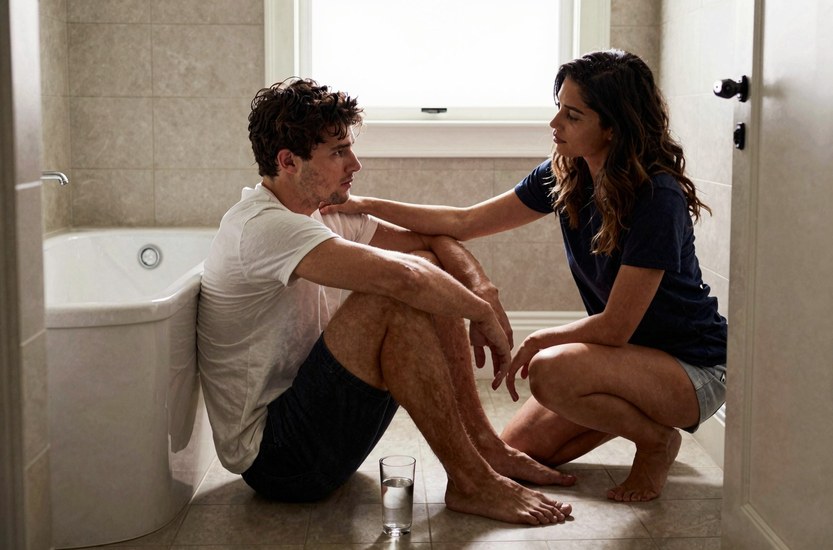
It’s one in the morning, your heart is racing, the room keeps sliding half a second behind your eyes, and one clear sentence forms: I think I’m dying. So you type “can weed kill you” into your phone and get a wall of “unlikely” and a forum full of “lol no, drink water.” This article answers the question twice: first for right now, in the next ten minutes, then for tomorrow, when you’re sober, still shaken and want the real numbers.


The short answer
What you are feeling has a name. It’s called greening out, and it’s what happens when you get far more THC into your system than your body is used to.
Your heart rate goes up. Your blood pressure can dip when you stand, which is why you got dizzy on the way to the bathroom. Your stomach turns. Your sense of time breaks, so five minutes feels like an hour, which makes it feel like it will never end.
And your brain, running on far too much THC, does what a brain does with a racing heart and a spinning room: it decides you’re in danger and floods you with dread.
That dread is the part that feels like dying. It’s a panic response riding on top of a physical reaction. It isn’t your heart failing and it isn’t your breathing shutting down. In a healthy adult, THC doesn’t do that, and the next section explains why.
Someone on r/trees wrote, mid green out, exactly what you are thinking: “Im currently greening out really hard and I’m just way too high and it feels like any second I’m going to die. Is it really possible to die from a THC cart?… Can I die? Please help.” (thread). The calmest reply in that thread got it right in one line: “It sounds like you’re having a panic attack.” It felt like the end and it was not.
If you smoked or vaped, the effects peak fast, usually within the first half hour. In a lab study, heart rate was back to normal within 3 to 4 hours, though some effects lasted up to about 6 hours (Spindle et al. 2018).
If you ate it, everything is slower. Edibles take 30 to 60 minutes to kick in and peak around 1.5 to 3 hours after you ate them (Schlienz et al. 2020). They also take longer to wear off.
How a green out usually runs
| Smoked or vaped | Edible | |
|---|---|---|
| Starts | Within minutes | After 30 to 60 minutes |
| Worst point | Within about 30 minutes | About 1.5 to 3 hours after eating |
| Heart rate back to normal | Within 3 to 4 hours | Later than after smoking |
| Last effects | Up to about 6 hours | Can drag into the next day |
A very large edible dose, especially in someone who doesn’t use often, can leave you feeling off well into the next day. That’s not damage. It’s THC being slow to leave your body. It does end.
Get low and stay there. Sit or lie down, because most of the physical injuries in green-out stories come from standing up and falling, not from the weed.
Drink water in small sips, not a whole bottle, because your stomach is already unhappy. Eat something plain if you can keep it down. Put on something you’ve seen a hundred times and know the ending of. If someone is with you, have them stay in the room and talk about anything boring.
Slow your breathing, out longer than in: four counts in, six counts out. A slow exhale is the one lever you have on a racing heart that doesn’t require you to believe you’re fine.
Don’t take anything else to “bring it down,” especially not alcohol or a pill you found in a cabinet. Every one of the real dangers in the next section starts with mixing.
Greening out on its own doesn’t need an ambulance. But you can’t always tell from the inside whether it’s only greening out, so here is the line.
Chest pain that doesn’t ease when you sit still. Trouble breathing, as opposed to fast breathing. A seizure. Someone who can’t be woken up. A child of any age who ate an edible. Anyone who also drank heavily, took pills, or doesn’t know what was in the cart. Any of those, you call 911.
If you’re somewhere in between and can’t decide, call Poison Control in the US at 1-800-222-1222. It’s free, it’s confidential, and it’s open 24/7, so they answer at one in the morning. Nobody there will lecture you about weed.
Part one: not the way you’re afraid of right now. There is no known lethal dose of THC in humans, and no confirmed case of a healthy adult dying from THC alone the way people die from too much alcohol, heroin or fentanyl.
The reason is anatomy. The brainstem keeps you breathing and keeps your heart beating while you sleep. It has very few of the receptors THC works on. Opioids act exactly there, which is why an opioid overdose stops your breathing.
THC mostly acts higher up, in the areas that handle memory, movement, appetite and mood. You can overwhelm those completely, which is what greening out is, and the brainstem keeps doing its job (Bhaskar et al. 2021).
The animal tests from the 1970s tell the same story. Rats only died at oral doses of several hundred to almost two thousand milligrams per kilo of body weight. Dogs survived up to 3,000 and monkeys up to 9,000 milligrams per kilo.
What does that mean for a person? An expert panel on medical cannabis cites a World Health Organization estimate: for a 154-pound (70 kg) adult, a lethal amount would be around 280,000 mg of THC. That’s more than anyone can smoke, vape or eat in one sitting before falling asleep or throwing up.
The best real-world check comes from England. A team reviewed every death reported to the national drug-death programme between 1998 and 2020 in which cannabis showed up in the body: 3,455 cases.
Deaths with cannabis in the body, England 1998 to 2020
| Group | Number |
|---|---|
| All deaths with cannabis found at autopsy | 3,455 |
| Other drugs involved as well | 3,319 (96 percent) |
| Cannabis was the only drug | 136 |
| Of those, injuries (mostly suicides and road crashes) | 84 |
| Put down to cannabis toxicity itself | 1 |
In 96 percent, other drugs were involved, most often opioids, and alcohol showed up in about 4 in 10 of all cases. Only 136 deaths involved cannabis alone, and most of those were injuries.
Exactly one was put down to cannabis toxicity: a very heavy smoker, several joints a day, with unusually high blood levels and nothing else found at autopsy. Even there, the researchers say it remains unclear how THC could have caused the death.
That single case is the closest thing to an exception in twenty-two years of national data. The authors put it plainly: the risk of death from cannabis toxicity is negligible (Rock et al., Journal of Psychopharmacology, 2022).
So when the top reply on that r/trees thread says nobody has ever died from cannabis alone, it’s close enough to right. Part two is where it stops being useful.
None of these are a lethal dose. All of them are real, and the “weed is harmless” crowd skips every one of them.
This is the one people underestimate most. In that same English review, most of the cannabis-only deaths were injuries, not poisoning: suicides first, road crashes a close second.
THC slows your reactions, narrows your attention and makes you overestimate how fine you are. That’s a bad combination on a highway. Someone greening out isn’t driving anywhere, but someone who is “just a little high” and confident often is.
Cardiologists in Boston interviewed 3,882 people shortly after a heart attack and asked what they had done in the hour before it started. The risk of a heart attack was 4.8 times higher than normal in the sixty minutes after smoking cannabis, and it dropped off fast after that (Mittleman et al., Circulation, 2001).
For a healthy 25-year-old, that’s a small number multiplied by a tiny number. For a 55-year-old with narrowed arteries who doesn’t know it, the racing heart of a green out is not just unpleasant. That’s who the chest-pain rule above is for.
This is the one place where “you can’t overdose on weed” is flatly wrong. A 30-pound toddler who eats a 100 mg bag of gummies gets, per pound of body weight, more than 50 times what a 180-pound adult gets from one 10 mg gummy.
US poison centers logged 7,043 cases of children under six eating cannabis edibles between 2017 and 2021. The yearly count went from 207 to 3,054 in that span.
Almost a quarter of those children were admitted to the hospital, some to intensive care. Most of the children whose outcome was known became very drowsy or hard to wake (Tweet et al., Pediatrics, 2023). If you have gummies in the house and a kid under six, they go in a locked box, not on a high shelf.
Weed plus a lot of alcohol is the classic green-out recipe. It’s also the classic way to choke on your own vomit while passed out.
Weed plus benzodiazepines, plus opioids, plus anything that sedates, is a different category from weed alone. It’s the category almost every cannabis-positive death in that English review actually belonged to.
Street vape carts have been cut with vitamin E acetate. In 2019 and early 2020, the CDC counted 68 deaths from the lung injury linked to it. Most patients who said where they got their THC products had bought them from friends, dealers or online (CDC). It killed them by destroying their lungs, not by getting them high.
Synthetic cannabinoids sold as K2 or Spice aren’t weed at all and are far more dangerous. And the fentanyl-laced weed you hear about is mostly rumor so far, but with street product you can’t rule it out. If you don’t know where it came from and you feel wrong in a way that isn’t the usual green out, that’s a 911 call, not a wait-it-out.
One more that gets skipped: the after-effects on your mind. Greening out is where a lot of first panic attacks happen, and for a small number of people it’s where a psychotic episode starts. Those don’t kill you either, but they change how the next months go.
If you want to know what a cannabis panic attack is and why weed sets it off, read Weed and Panic Attacks: Why Cannabis Triggers Them. If your green out included believing things that weren’t true, hearing voices or losing hours you can’t account for, the more important read is Cannabis-Induced Psychosis: What It Is and Who Is at Risk.
Go through r/leaves, the subreddit for people quitting weed, and search for “greened out.” You’ll find the same post over and over, written the morning after. Here is what happened, here is how humiliating it was, and I am done.
“Been a heavy daily smoker basically since I turned 21 (so 6 years now),” one of them starts. This person had been working from home and got far too high on a pen. “It’s a minor miracle that I managed to get through my workday without anyone needing something from me… I’ve quit for months in the past, but this time really has to be for good.” (thread). The top reply under it is the most honest sentence in the whole discussion: “cut to me face down on the bed spiraling out thinking about every mistake I made in life trying not to throw up. Still would smoke the next day. That’s addiction for you.”
That reply is the whole problem. A green out is the loudest signal your body can send that you’ve gone past what it wants. For a daily smoker, it usually changes nothing by the next evening.
The loop many daily smokers know
The ones who do quit after it are the ones who were already halfway out the door and needed a push.
“has anyone experienced greening out where you have a massive panic attack and just can’t think straight?” someone asked. “i experienced that yesterday and now i don’t want to touch it ever again.” (thread). Another person in that thread had the same night two weeks earlier: “It surely wasn’t just the weed but the weed sent it over the edge. Something I never want to experience again and haven’t had a single craving of weed since.”
There’s a second group here worth naming: the ones who had already quit. Tolerance drops fast in the first weeks off, and the amount that used to be a normal night becomes a green out.
One person on r/leaves, a month clean, took an edible on a bored Saturday night. “I started with 30 mg and felt completely normal after 1.5 hours so I decided to take 20 mg more… and when it finally kicked in I’ve never felt worse in my entire life.” (thread). Someone else, 120 days sober, slipped at a celebration and spent four hours on a lawn, then wrote: “I’m sad. I’m aching. I’m disappointed. I’m ashamed. And I’m never smoking again.” (thread).
If that’s you this morning, two things. The slip doesn’t erase the days before it. And the reason it hit so hard is that your body had already started to recover. Your receptors were coming back, your normal dose was no longer normal, and the green out is the proof.
The part nobody tells you: for a lot of people the fear doesn’t end when the high does. The heart-racing, floor-tilting feeling gets stored. Days or weeks later, sober, in a supermarket line, something small sets it off again.
If the world has looked slightly unreal since that night, like you’re watching yourself from a step behind, that has a name too, and it fades. Read Derealization From Weed: Why It Happens and How Long It Lasts.
In our Cannabis Detox Program, the stretch from about day 5 to week 3 or 4 is the Resilience phase. A green out as the last night of smoking can make it louder, because you enter it with a nervous system that has just been through an alarm. It still settles. It just doesn’t settle on the timeline you would pick.
So, can weed kill you? Not the way it feels like it can at one in the morning. It can get you killed in a car, push a heart that was already in trouble, put a toddler in intensive care, and be the thing you mixed with something that did the actual damage.
And it can be, if you let it, the night you finally stop. The floor is a bad place to make that decision. Tomorrow morning is a fine one, and our Cannabis Detox Program takes you through all three phases from there.
Not from the green out itself. The racing heart, vomiting, dizziness and dread are your body reacting to too much THC, and they pass on their own within hours. What can hurt you during a green out is falling when you stand up, choking if you pass out drunk as well, or an underlying heart problem being pushed by the raised heart rate. That's why you sit down, skip the alcohol, and call 911 for chest pain that doesn't ease.
For an adult there is no known lethal amount of THC, and no confirmed death from THC alone in a healthy adult. Greening out, meaning being far too high to function, starts at very different amounts. In a lab study with people who rarely use, a 10 mg edible was clearly felt and 25 mg already caused marked impairment. A daily smoker might need several times their usual amount. That gap is exactly why people who quit for a few weeks and then take their old dose end up on the bathroom floor.
It's rare, but children are the one group where the answer changes. A small body and a large dose can make a child dangerously drowsy and hard to wake. Any child who has eaten cannabis, even if they seem fine, needs Poison Control (1-800-222-1222 in the US) or an emergency room, because symptoms can take hours to appear and get worse while the child looks sleepy.
It can trigger one in someone whose heart was already vulnerable. In a large study, the risk was about five times higher than normal in the hour after smoking and dropped back after that. In a young, healthy person that's a small risk multiplied by a very small one. In an older smoker with high blood pressure or existing heart disease, it's a real reason to stop.
Smoked or vaped, the worst is usually over within a few hours, and heart rate is back to normal within 3 to 4 hours. Edibles start later, peak around 1.5 to 3 hours after eating and can leave you groggy the next day. If you still feel shaky and anxious two or three days later, that's no longer the THC. It's your nervous system staying on alert after the scare, and it's worth reading about panic attacks and derealization above.

About the author
Maik R. · Copywriter, QSW Team
Maik smoked weed daily for more than 12 years before getting clean with the support of an addiction counseling service, where he later worked himself. Today he writes for quit-smoking-weed.com from abroad, combining lived experience with careful research on withdrawal and life after weed.
More about Maik →QSW-Team · 15. September 2026
You're standing in the cereal aisle. The light is too white, the shelves look flat, like a photo of shelves, and your own hand on the...
Read more »
Maik R. · 4. June 2026
When people talk about what weed does to your brain, the conversation usually focuses on the damage side. What happens after is discussed much less, even…
Read more »
Ben C. · 1. June 2026
Cannabis has been caught in a strange cultural tug-of-war for decades. On one side: the narrative that painted it as almost universally destructive. On the…
Read more »
We use cookies and similar technologies to store and access device information. By consenting, you allow us to process data such as browsing behavior or unique IDs on this site. Not consenting or withdrawing consent may negatively affect certain features and functions.