
How to Detox From Weed at Home: What Actually Speeds It Up (and What Does Not)
Maybe the drug screen is on Wednesday and you've had the same tab open for an hour. Or there's no test at all: you quit on...
Read more »

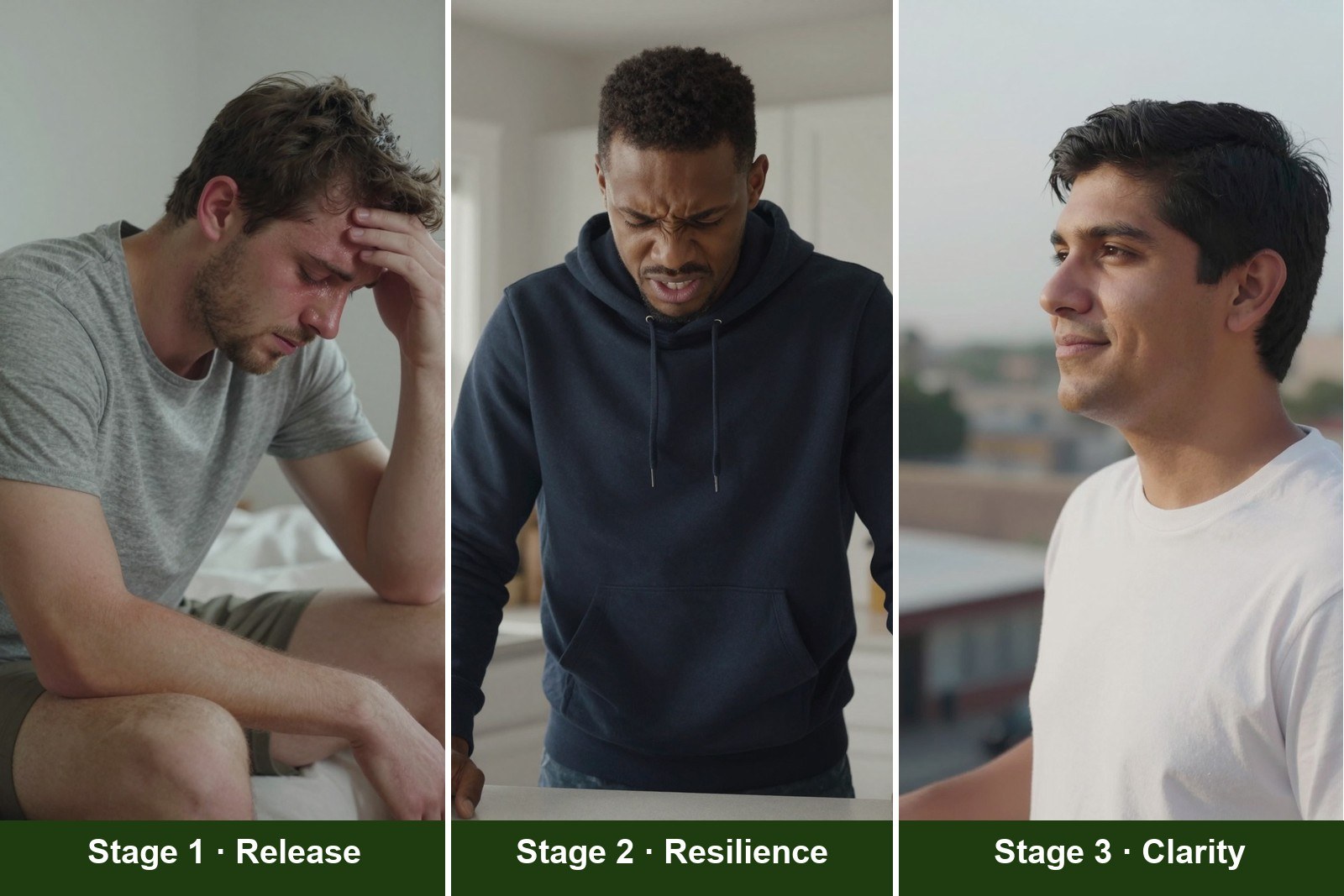

After years of daily use, your brain runs with fewer of the receptors THC docks onto. When the THC stops, the system has to rebuild, and that takes time. A brain imaging study found that these receptors, which had dropped in daily smokers, were back to normal after about four weeks without cannabis (study on CB1 receptors in daily smokers). That rebuild is why withdrawal arrives in stages and not all at once.
In our Cannabis Detox Program we split it into three stages: Release runs from day 1 to about day 5, Resilience from day 5 to about week 3 or 4, and Clarity until about week 7. The first is mostly physical, the second is both, the third is mostly mental.
The three stages after your last use
The classic study here followed daily smokers through 45 days without cannabis. Symptoms usually started on days 1 to 3, peaked on days 2 to 6, and most were gone within 4 to 14 days (Budney study on the time course of cannabis withdrawal). A review of the research adds the split that matters for you: physical symptoms and aggression tend to start sooner, peak sooner and fade sooner than sleep problems and mood changes (review of the cannabis withdrawal syndrome).
These are averages, and the borders between stages are soft.
Day one and two often feel almost fine. THC is still leaving your system, and the decision itself gives you some energy. Don’t take that as proof it will be easy. By day three your body is making a lot of noise, and the thought that something must be medically wrong crosses most people’s minds. We’ve been there: day three or four is usually when the body is loudest.
Picture it. You fall asleep from pure exhaustion, wake at 2am drenched, and lie there until the alarm goes off. At lunch you stare at food you would normally have finished. In the research, cravings and sleeplessness peaked around day two, and irritability, restlessness and anger around day four.
The typical Release symptoms:
Not everyone gets all of them. Most people get a handful, and the physical ones are the first to fade. If you cannot keep fluids down or feel truly unwell, get medical help instead of waiting it out.
Around day 9 you sleep a little better, the sweating has stopped, and you think the worst is behind you. Then on a Tuesday evening you sit down in your usual spot, snap at someone for nothing, and a thought arrives that sounds perfectly reasonable: maybe it wasn’t even that bad. This is the stage where the body quiets down and the head gets loud.
Honestly, we’ve seen this firsthand: week two is usually harder than week one, just in a different way. The physical noise used to drown everything out. Now there is room to feel what weed was covering, and the old routines have nothing to hold onto.
What you may still feel physically: patchy sleep, vivid dreams, tiredness, the odd sweaty night, and appetite slowly returning. What takes over mentally:
Because you feel physically better, this stage is also where a lot of relapses happen. A craving in week two is not a sign the quit is failing. It is the wave of this stage, and it passes.
Free E-Book
You want to quit weed, but it feels impossible to actually stop?
Our free e-book shows you why willpower is a lie and the exact steps you need to quit for good. Enter your email below and we’ll send it to you for free.
It is a Friday evening, nothing is planned, and your body feels fine. You slept well all week. And yet the evening feels flat, as if someone turned the colour down. That gap is exactly where weed used to sit, and it is the typical Clarity moment: the body has mostly recovered, and your mind is learning to fill the space.
Physically, sleep is close to normal, appetite is back and the sweats are gone. What is left is mostly mental, and it tends to ease week by week:
Clarity does not run in a straight line. Expect good days and bad days mixed together, and a bad Thursday in week five does not put you back at zero. For the bigger picture, see how your brain recovers after quitting weed. After very heavy, long-term use, low mood, poor sleep and anxiety can come and go for up to about 3 months, in waves that get weaker over time.
You can place yourself by your main complaint. If it is sweating, no sleep, no appetite and a churning stomach, you are most likely in Release. If your body is calmer but you are irritable, anxious and fighting thoughts about using, you are most likely in Resilience. If your body is fine and the main problem is a flat mood and habit cravings, you are most likely in Clarity.
Your own pace depends on how long and how heavily you used. Women also tend to report stronger withdrawal symptoms than men (review of cannabis withdrawal and sex differences). If you want every symptom explained in detail, read our complete guide to weed withdrawal symptoms.
The 3 stages of cannabis withdrawal are a map, not a schedule. You will not hit every day exactly on time, and that is not a sign you are doing it wrong. So when the Tuesday evening comes where you snap at someone and start bargaining, check the map before you check the stash. You are probably in Resilience, and that stage ends.
Release (day 1 to about day 5) is mostly physical, with sleep problems, sweating, low appetite and stomach trouble. Resilience (day 5 to about week 3 or 4) mixes physical and mental symptoms, with irritability, anxiety and cravings taking over. Clarity (until about week 7) is mostly mental, with a flat mood and habit cravings fading as focus and energy return.
Physically, Release, with the peak on days 2 to 6 in the research. Emotionally, many people find Resilience harder, because the body feels better and the cravings and mood swings have nowhere to hide. That is why week two catches people off guard.
Release lasts about 5 days, Resilience until about week 3 or 4, and Clarity until about week 7. After very heavy, long-term daily use, the full recovery can stretch to about 3 months.
Yes. You can have a night of Release-style sweating in week two or a flat evening in week one. The stages describe what dominates in each window, not a hard border. Heavier, longer use usually means more overlap and a longer tail.
Get medical help if you cannot keep food or fluids down, if you feel physically very unwell, or if anxiety, panic or low mood becomes severe or brings thoughts of harming yourself. A doctor can treat individual symptoms and rule out other causes.
Sources: Budney et al. 2003, The time course and significance of cannabis withdrawal; Bonnet and Preuss 2017, The cannabis withdrawal syndrome: current insights; Hirvonen et al. 2012, Reversible and regionally selective downregulation of brain cannabinoid CB1 receptors in chronic daily cannabis smokers; Schlienz et al. 2017, Cannabis withdrawal: a review of neurobiological mechanisms and sex differences; Connor et al. 2022, Clinical management of cannabis withdrawal

About the author
Maik R. · Copywriter, QSW Team
Maik smoked weed daily for more than 12 years before getting clean with the support of an addiction counseling service, where he later worked himself. Today he writes for quit-smoking-weed.com from abroad, combining lived experience with careful research on withdrawal and life after weed.
More about Maik →Maybe the drug screen is on Wednesday and you've had the same tab open for an hour. Or there's no test at all: you quit on...
Read more »
It's day three, the cuff is still on your arm, and the number reads 148 over 94, when two weeks ago, still smoking every night, it...
Read more »
You expected the irritability and the bad sleep, but the stomach stuff catches a lot of people off guard. Your appetite vanishes, food sounds terrible, and…
Read more »